Tuesday, October 30, 2012

Building land = Hen's teeth


I started bashing out a rushed reply to the following comment, and then realised that the reply might build up to be as long as a proper post. So why not? Why not a proper post as a response? So here it is...

almita said...

Hi! I live in Zurich and we are considering a Huf House project...So far we are looking to nuy a house and demolish, as you know there are no bauland, and the ones that exist are unaffordable. So far, I have found aorund the Zurich proximity at avge 1.5 mill Chf...sigh....

My question is about planning permission, I am looking for a house around 200 sq mts, or similar to yours, I like the flat roof model, did you have any challenges to get permission?

On another note, I see you mention an architect, do you need to hire one mandatory? We are hoping to benefit from the strong chf vs euro, after a few years, do you recommen the approach vs a traditional build after you had some time to live on it? thank you for your tips any wordof advise welcome!


The easiest place to begin is with the real estate situation here in Switzerland.

Strangely, Swiss mortgage interest rates are at their lowest since records began, the housing market forgot to plummet along with the rest of the world, the economy is more or less intact... and so, wonder of wonders, Switzerland seems to be the last bastion of rock-solid house prices, and, therefore, rock-solid land prices.

Or the land prices would be rock-solid if the damn things didn't keep going up up up.

Going up? We can understand the prices remaining stable, but going up?

So what's going on?

Well, a combination of factors: the obvious one is that most of the flat bits of land around this part of Europe were thoughtfully claimed by France, Germany and Italy, using little more that swords, ploughs and crosses, leaving the steep and rocky bits for the Swiss to scratch out a living. Ergo, any remaining flat land in Switzerland invariably has a tractor upon it, and very strict laws against conversion into residential use. Next, the Swiss understandably want to live within a few kilometres of wherever they work. This is a life/work balance thing that they've got right and therefore that everyone else has got wrong.

Ergo, too little available building land for geopolitical reasons, and certainly too little around the few cities that anyone with the wherewithal to spend tonnes of money building a Huf Haus could conceivably work in.

So land prices go up up up, because the bulk of it's been built on yonks yonks yonks ago. And there's not much more to come, unless the Swiss decide to annex Belgium.

Kind of sets the questions above into context, methinks.

So, to make my first point: yes, finding land that happens to have a wreck, 60's bungalow, or otherwise undesirable object, upon it, is a worthy strategy. Certainly a more successful strategy than searching the classified for that hen's tooth of a grassy building plot. That doesn't exist, so don't even look. And that's the thing about Swiss real estate that Auslander's (you lot) don't know; undesirable houses are worth... pretty much the value of the land it sits upon, and nowt more.

The Swiss rarely renovate. Maybe they don't have to, cos their well-designed, well-built and well-maintained houses don't actually get round to falling to bits. But very occasionally a wreck or dump does become available when some aged miser finally pops his clogs, and the inheriting family are clueless what to do with it. Selling's a lot easier than cleaning it. Or painting it. Or replacing kitchen and bathroom.

So worth keeping an eye out for.

Planning permission strategy? Well, Switzerland's pretty much like the rest of Europe. There are Gemeindes (local authorities) that like the idea of something like a Huf Haus, and then there're the many, many Gemeinde's wot don't. The ones that do like the idea tend to be more urban, closer to the lake, in lower tax areas (let there be no obstacle to relieving the rich from the burdens of taxation); the ones that don't tend to protect their cheerful Swiss villages by ensuring that any new house conforms to the steep, red roof uniformity that makes them so quaint in the first place.

Actually, fair dos on that point.

And specifically to answer the question, anywhere like Meilen, Richterswil, Kusnacht and Erlenbach would do nicely, if seeking to build a flat-roofed Huf Haus. At twice the land prices of anywhere else, cos they're low taxation areas, purposely set low to attract the rich, 'cos the (low) taxable income of a handful of rich is mightier that the (high) taxable income of the great unwashed.

Anywhere more rural-like where yer perfect Huf Haus would have the perfect view to match would likely be guarded by a Gemeinde planning department (in practice one bloke) who will fight you tooth and nail, unless he's one of the very few enlightened. And when you best the planning department (him) using the full legal powers that you're entitled to (entitled to pay handsomely for, that is) you'll have found that two years have passed, and maybe, just maybe, you've gone off the whole idea. Sod it.

Which is exactly what happened to the previous owners of the land upon which our Huf Haus sits upon. They battled for two years, got pissed off with the endless stream of obstacles (to be fair, they wanted a few additions that would be hard for any authority to swallow) and even though they won most of their hard fought battles, and got that planning permission (sans unpalatables) the magic had gone. So they flogged the land with planning permission for a Huf Haus to Claudia and I, and then waved goodbye to this particular Gemeinde forever.

The little beaurocrat will out in the end. He's now working in the (bigger) Gemeinde next door leading a planning department of three, with governance over his successor at our Gemeinde. The power, the power. The Webers (for it was they) moved to Bern, and chased other dreams.

Still, not a bad plot of land for Claudia and I to find on our second weekend's drive round the Zürich area searching for hen's teeth. And with a fresh Baubewilligung (permission) for a 3-axis Huf Haus of the same shape and size as we wanted. We changed almost nothing. Saved us a year or two of wrangling. Sigh. You may call us what we are. Lucky, lucky sods.

So what's my advice to the world, assuming not everyone is quite as jammy as we were?

Build in an expensive (low tax in the case of Switzerland) area and find that CHF 3 million for the land. They'll let yer build an Eiffel Tower out of lollipop sticks and donkey spit if it'll mean your income'll contribute to the tax pool of the area.

Can't afford that? Then look further out, and conform conform conform. Conform as much as the Huf Haus system will allow, anyway.

If the local (Gemeinde) planning regulations stipulate a certain size, roof profile, distance from road or boundary, building colour, or whatever, then submit a plan wot says exactly that. Nay! Make it even more conservative, and slice 50cm off every dimension, include a wall or hedge to protect the neighbours from the "horror" of looking at a Huf Haus... actually, to protect your view from their derivative blot, but the Gemeinde doesn't have to know that. If they demand red roof tiles "to fit in with the character of the village" then get used to the idea. If they insist on a pitched roof "because of the threat of snow overwhelming the structure of the house" then give up on the flat roof idea.

Or build elsewhere.

Or build something else.

Or don't build.

Stop! All too negative! Look, your Huf Haus system can be physically tailored to fit into almost any set of planning rules. Few, if any, regulations stipulate a maximum window surfacing, or the colours of the walls or beams. Yer pitched roof comes with roof tiles, which is as conservative as it gets, so they can't bitch about much more than the colour. The structure (post and beam, pitched roof) itself is as traditional as it gets in Europe, short of a mossy cave.

But how to add those features to make it special?

Well, the inside's a blank canvas for a start. But this post's inherently about the outside, so inside's for another day.

There're various things you can do outside that can equally conform to the planning regulations, if you're guided properly. Which is how I answer the second question. Yes, you need an architect. But not just anyone out of the Yellow Pages. In Almita's case, that architect's basically Mr Huf Haus Switzerland (not the case when he built our house, merely the recommended architect, but the meek inherited the franchise) and I can recommend him wholeheartedly. No one has better experience as to what fits into local regulations, Huf Haus-wise, than he (actually, He of the Bowtie, none other), and no one knows better how to deal with the factory, arrange for blokes with diggers to make keller-shaped holes, yadda yadda yadda.

And that'll be the case anywhere else in Europe. Talk to the Huf Haus people, and let them recommend the architect. Skip the suspicion that it's some kind of job for the boys. Because it is a job for the boys. Tried, tested and proven boys.

And would I still recommend building a Huf Haus rather than a traditional build?

Well, watch Grand Designs and see for yourself. Everyone else is grateful for the project part to be over, for the planning arguments to be at an end, for a stop to the disappointments with building contractors, with the spiralling costs, hurrying Mr McCloud past this or that unfinished room years after they moved in. Sod that. Claudia and I still think back to the project part of our build as one of the best experiences of our lives, and for the good reasons, rather than for those character-building reasons that other people have to cling onto.

Not meaning to disrespect the traditional build mob, or their choices, you should understand. They've earned plenty of my respect as I watched them (on the telly) overcoming all sorts of adversity that I couldn't be bothered with.

Please, Dear Huf Haus Hopeful, do cast your eye across the above words a few times more, and try not to let your dream get twisted from the outset by an unnecessary (losing) battle with the authorities. Why make it hard for yourself? Conform enough to meet the regulations, using the sage advice given by experienced professionals, and even if you do have to make some compromises, I can promise you one thing, and these are the exact parting words of the embittered Frau Weber who sold us the land:

It'll easily be the nicest house in the village.

And by christ, she was right. It is, and then some.

Tuesday, October 09, 2012

The wonderful world of Ligne Roset furniture

Hello World!

Firstly, an apology as I've been meaning to write up Ligne Roset (a contemporary Italian-French furniture company) for donkey's years. Ah well, better late than never. Hopefully no one's going to read this, fall into a rage, and then smash up the furniture they've bought in the meantime.

Let's face it, yer Huf Haus has such amazing natural light and cat-swinging space, that it's an ideal gallery in which to show off decent furniture. Looking at the many eye-candy pictures of Huf Haus interiors that we find on the Web and in the magazines, it seems that Claudia and I are not alone when it comes to our taste for mixing our furniture styles up. To our eyes (your tastes can and will differ) nowt looks better than a mélange of contemporary, classical and even ethnic furniture, side by side, because somehow the clash of styles allows each piece to stand on its own two feet.

Or four feet.

Whatever.

For my sins, back at the turn of the millenium, I spent a year or two living in the fair city of Luxembourg. A surprisingly nice place, but of course somewhat limited in the excitement stakes. Nevertheless, there were enough colleagues and friends around at the time to generate enough fun, high-jinx and mayhem for me to recall my Lux stint as one of life's high-points.

I arrived there (as oft happens to we ex-pats) for "just a few weeks" and then quickly figured out that I'd be there "much longer", and therefore would be "needing an apartment". And that apartment would "need furnishing"...

(Let's fast forward...zzzzzzzzzzzip)

...so of course my newly acquired apartment would need some decent furniture. It just so happened that there was one of the few Habitats outside of the UK right there on the door step, so my credit card got a bit of a pounding. But then I wanted a few items that would be... just a bit nicer... than what Shabby-tat had to offer.

Sooooooo, in some fancy furniture shop close to Grand Rue (sort of Lux's version of Bond Street) I spotted an amazing glass coffee table, hyper-ventilated at the price, bought it anyway, and took the catalogue home to scratch and sniff at the other wonders therein... and so started my love affair with all things Ligne Roset.

So why, amongst the oodles of contemporary posh furniture manufacturers do I offer you Ligne Roset?

Well, 'cos over the years I've noticed that lesser brands shameless copy Ligne Roset classics using cheaper materials, physically scaled down to fit the shoe-box sized rooms of yer typical house, and stamp 'em out in China (or wherever) by the thousands and charge... well, to be honest the rip-offs are cheaper, but not exactly a tenth of the price of the originals. Typically a half or a third of the price for smaller versions badly made out of far less durable materials. So yes, I'd heartily recommend that when you have a chance to pop into a Ligne Roset store that you have that walk round, grab this year's catalogue (some people avidly collect the catalogues like stamps, I kid you not) and see if they're for you and yours.

So what follows is a short roll call of what's caught my eye over the years, some of which Claudia and I are living with now, some of which we'll buy when we get round to it... and some of which'll have to remain on the lust list because there's no logical place to put it.


Smala sofas

So let's start off with the Smala sofa, a pair of which Claudia and I nearly bought just before Rafael was born. Costs are about three and a half grand for the big three-seater and two and a half for its two-seater little brother.

And that's a hocker you see in the corner of the photo. The sides and backs of the sofas have clever mechanisms so that they can be incrementally raised and lowered either for comic effect, or, more realistically, so that they can be fully flattened out into sofa beds. Achingly cool, and available in a zillion colours, fabrics and also leather for the fetishists. Reason we didn't buy? Someone with some experience of parenthood (Rafael would be our first child) pointed out the potential for baby-sick, chocolate and melted biscuits to somewhat spoil the look and finish of said sofas. So we bought a cheaper throwaway corner sofa until the detritus associated with our kids has safely dried up.

We can wait. But until then... drooooooooooool.


Togo sofa combos

Ok, so this is what happens when yer act against your instincts and use the left-side of yer brain (the brainy side) to rationalise a delay; the right-side of your brain (the fickle side) changes its mind. Or does it? Too fickle to tell...

So I present you the Togo sofa system, available either as corner unit combinations, or as separate sofas, etc etc etc. Costs are about three and a half grand for a three-piece corner combo. And of course it's available in more colours than Joseph's coat. Why's it caught my eye? Well apart from looking like the comfy-est sofa available anywhere. Period. I turns out that it is the comfy-est sofa. Ever. Period. So there.

Your cat will love you forever. And then some.


Good Morning side table

Ok, so for just under four hundred quid, we have the Good Morning side table. Sounds like a chinese cigarette brand. Bonkers name, but thankfully it's not written anywhere so yer visitors don't have to know.

This is one of two side tables that Frau Capucho and I have in consideration at the moment.

While it seems to defy the laws of gravity, it's clearly not quite toddler-proof. However, our youngest Alexandro (we have three boys) is now nearly four, and seems to have passed the "lets give that table a nudge to see if it (and the big vase of flowers on top) will come crashing down strewing flowers and associated green water all over the lounge" phase...


Thot side table

...or perhaps we go with the Thot instead. Say wot? Yep, another comedy name in the vein of "Thor? THOR? I'm tho thor I can hardly pith!"

Nevertheless, a smoothly modern design available at a Ligne Roset store near you (or someone you've read about in the papers) for give or take four hundred quid.


Everywhere storage system

Ok, so here's one for which we actually coughed up good money; no regrets.

We spent about two thousand quid around ten years ago for a two metre unit to go under our big telly. It's still looking strong, clean, neat and (most importantly) capacious (those drawers are huge) seeing as we have those zillions of CDs and DVDs that yer seem to accumulate.

And look at those feet! Actually, you can't 'cos it's a crap photo. But if you could you'd recognise them because they're so copied that they've become a bit of a cliché. Look for them in Ikea or wherever, and once you start noticing them you'll never stop. A bit like humming that song... can't stop yerself.

Anyways, it's the prototype, the original, the real deal and I never get tired of looking at it, or its brethren, in the Ligne Roset shop.

(Sigh).


Bianco dining table

We didn't buy the Bianco dining table, but oh how I wish we had. Nay, we will! This is another modern design classic copied outrageously by others. Costs about two and a half grand, and it's soooo very clever that it hurts. The table slides smoothly apart in't middle (have a close butchers at the photo) in such a way that your dinner guests will applaud loudly. Although you probably should have set the table before they arrived.

Still if they did see the expansion then they'd be well impressed.

Our current dining table is a 2.4m cherry-wood dream that we bought to fit into our old house, which simply doesn't fit under the viewing gallery space above it. Basically, it's too nice to replace, but needs replacing anyway. Leave this one with me, and I'll continue to erode my beautiful wife's objections.

Might take years.


Fils dining chairs

Well, we can't have the dining table (pah! just you wait!) but we can bloody well have the chairs. So we have ten. They cost three hundred quid a pop, are comfortable, cool, strong, wipe-clean (kids), and for an extra fifty quid you can have moo-moo cow-hide in place of the coloured leather. Yep, two of our chairs are cow-hide and they look great!

Now you should understand that the Swiss are very particular about designer chairs (dunno why, but they are) so they can happily chat about just about every modern (and old) designer that ever bent a piece of metal into a seat. However, these Fils chairs never fail to impress, and I do rather enjoy them mentally trawling through their design catalogues before arriving at... the name of the wrong designer. Hah!

Kenny Everett voice: It's Ligne Roset, you fools!


Everywhere desk

And here's the Everywhere take on the home office desk, a mere bagatelle at one and half thousand quid.

Not yet bought, but it will be any time soon. Shall wait for the wife's birthday to come around, so (shh) let's keep it to ourselves, eh? And have a look at the feet under the drawer unit, 'cos that's the design cliché I was referring to before. Look!

Do you see 'em? Do ya?


Mama standing light

Last but not least, we have the Mama standing light. Almost a daft name, but still within acceptable limits of naming credibility.

This is another Ligne Roset classic that graces our home, and it's lighting up me and my iPad as I finish typing this post. Ok, so it's six hundred quid, but what price for (yet again, this is getting embarassing) an oft copied modern design classic. What's so clever about this (one does so like clever things) is that the metal hangy-over bit slides back over the metal standy-up bit so that it can be converted from hangy-over to standy-up.

Oh for god's sake have a look at the photo because written words don't describe this very well.

My written words, anyway.

That's all for now, and see you all next time.

Friday, November 13, 2009

Any questions?

Hi World,

Well, our Huf Haus has been complete for well over two and a half years, and therefore you shouldn't expect too many updates going forward. Or going backwards, either.

Anyways, I'll probably add a post or none each year as and when our car port (finally) gets built, and the garden (finally) gets terraced. However, all such home improvements are subject to the size of my annual bonus... which is subject to the performance of the financial markets... which are subject to the competence of the investment bankers.

So not much bonus expected then, hence no improvements, hence nowt to write about.

Anyways, I've received a couple of Huf-related emails recently, and both queries mentioned what a buggah it was to track down my email address. Hmm, I think the difficulty was the point. Can't receive too few emails, eh?

So here's the official Capucho Query Policy: assuming yer not too shy, then write yer queries as "comments" against this post like wot everyone else does. If your query is a bit too much of a private nature for public consumption (yer planning an S&M dungeon in yer Huf Haus cellar, or whatever) then the unofficial Capucho Query Policy is to email me directly at ric.capucho(at)gmail(dot)com.

Regards to All,
Ric
Update, October 2012. I'm up and blogging again, so forget all this farewell nonsense...

Thursday, April 10, 2008

Kitchens

I've received a couple of emails over the last year or so, plus the odd comment, asking me which kitchen company we used for our own Huf Haus and why. Well, here's the post I've been meaning to write to give a full and structured answer.


The Capucho kitchen (by Leicht)

One thing that's very noticable when going through the design of your dream Huf Haus is that the Huf people don't include a "standard" kitchen as part of the "standard" house.

Compare that with the bathroom situation where a decent standard comes as, erm, standard, and then a set of options can be applied to upgrade it right up to posh hotel levels of luxury. And if that's not enough for yer, then they have their StilART people waiting in the wings who can design you a bespoke solution, at a cost mind, which would make the Onassis family jealous. But I'd say that 99 times out of 100, there's still plenty of the standard bathroom somewhere underneath even the wildest StilART creation.

So why don't they offer a similar approach for kitchens?

Well, it's because kitchens are too personal, too emotional, too non-standard by their very nature. 99 times out of a 100, the Huf owner wants something different; something completely different, as the Monty Python people would say. So the Huf people pragmatically offers us a 'kitchen base' as part of the package, and that base includes the following:

  • Floor tiles - similar to the bathrooms and entrance areas
  • Water pipes sticking out of the walls
  • Electric sockets in the walls
  • Electric cables sticking out of the walls
  • Painted walls and ceiling
  • Glass in the kitchen window
  • Air
  • Erm, that's it

    Lemme see, I'll carefully review that list to see if I've forgotten anything. Da di da di dah. Nope, it's all there.

    Now most people would consider that to be a bit too minimalist, although I have a mate who wouldn't notice as long as he has somewhere to plug in a kettle. But for the rest of us the concept leads yer to two possible solutions: Call in the StilART people, who will suck on their pencils and work with you to design your wet-dream of a kitchen; or to call in some non-Huf related kitchen people to do likewise.

    What's important to remember is that the water and electrical channels are built into the very guts of the Huf Haus, so whatever kitchen layout you end up going with needs to be with the Huf people before they start to manufacture yer house in their Hartenfels factory. They'll make a few clicks on their CAD-CAM design software and lo and behold yer electrics and water'll be in the right places when your kitchen people turn up months later to do their work. As we found out, they have some limited flexibility to move a few water pipes and electric cables about once the house is up and standing, but they can't make any radical changes without open heart surgery - and that comes at a serious cost.

    So yer want to have a kitchen layout figured out before the build, or you're sunk.

    The second thing to remember is that no pesky kitchen installer is allowed anywhere near yer Huf Haus until after the formal handover. This might seem like a case of over-formality, but there're a myriad reasons that make this a necessity: site insurance is an obvious one; workers tripping over each other, is another; water and electricity flowing as needed - or not flowing, as needed; floor tiles in place; etc etc etc.

    So, here's a recap of the research that Claudia and I went through before landing on our own kitchen.

    During our trip to Hartenfels, we had an afternoon with the StilART people; mostly on the bathroom 'cos we wanted a fancier double sink unit than comes as standard. Anyways, we also discussed the kitchen 'cos the setup in the showhouse really did look good. We left them with an outline of what we had in mind, and then waited to see what their offer would cost out as.

    In parallel, we looked at some of the fancier kitchen suppliers that we're up to our necks in around Zürich.

    First stop was Poggenpohl, a German manufacturer.


    Poggenpohl - 250% of our budget

    Now you should understand that out here in Switzerland there are people who would rather cook on an open fire built into a refugee camp gutter than to choose anything other than Poggenpohl. It's posh, it's stylish, it's tasteful, it's the tip of the top. We walked into a veritable Aladdin's cave of cool kitchens, drooling as we looked left and right.

    Unfortunately, Poggenpohl's also bloody expensive.

    The 'representative' took one look at my shoes and clothes, and then rushed us through a design to see how the costs might look. That quick estimate told us that the bare units without the electronics yer might need for cooking, indeed without the doors yer need to hide them pots and pans and cutlery, would be significantly outside our price range. Like 50% more than we had in our budget for the lot. I'm serious. We exited stage left feeling like tramps that had accidentally walked into Claridges instead of the soup kitchen next door.

    Oops.

    I have to stress that the Poggenpohl bloke was really very tactful with us, and very likely saved us all a lot of time and bother.

    What would I recommend to you? Well, in theory yer Huf Haus is the Bentley of "factory-made component houses", so it deserves the Bentley of the kitchen world. Is that Poggenpohl then? Well, very likely. They're both German nowadays anyway. Maybe Claudia and I were in the wrong movie, as they say, and massively unbudgeted for what should be a significant cost in our Huf Haus project? Maybe we really are skinflints, and we should have devoted about 10% of the entire project budget to the bloody kitchen. But we didn't, so there.

    Go and see for yourself, and if yer appetite and budget stretches to Poggenpohl, then go for it. What they have is beautiful, truly beautiful.

    Next stop was with a local supplier who handles the SieMatic brand, also from Germany.


    Siematics - 120% of our budget

    The first thing we did was to establish whether we could afford the bloody prices. This rather upset the salesman who's more used to discussing such indelicacies as dosh somewhere towards the end of the sale process. Preferably while you're reading the final invoice placed upon the worktop of your new kitchen that'd been installed some weeks previously.

    Slimey salesman git.

    Still, this was our first opportunity to do some real research. And here's what we found: The better of yer modern kitchens have doors and drawers that don't make scraping and banging noises when you shut 'em. Oh no. They slide almost shut in a single silky motion, and then, by virtue of their built-in dampers, slowly but surely close the last bit all by themselves. The drawers themselves should be made of wood laminate or metal, and abso-bloody-lutely not be made of plastic. As goes the cupboard and drawer handles; if they have 'em, 'cos the fashion these days is to have door-width slots to break yer finger nails in. And yer can stand in them drawers, and in fact when you open the bottom drawer in the kitchen showroom, look for footprints. If there aren't any, flag a passing pimp, erm, I mean helpful kitchen salesman, and dare him to do it. The door surfaces should be as hard as nails, nay harder than nails - as hard as a decent kitchen surface which is very very hard indeed. The designs themselves are too subjective for me to discuss here, but for sure the kitchen range should include something that'll make yer dreams come true.

    And SieMatics of Deutschland offers you all of the above.

    Indeed, as we found out a little later, it may be the cheapest entry to that level of quality that's available here in Switzerland. Your experiences in the UK or elsewhere might differ, but have a butchers at those details just in case.

    Well, the pimp salesman did for us, so we moved on... and up up up to Bulthaup.


    Bulthaup - 200% of our budget

    How best to describe Bulthaup? Well, Swiss designer stylish. Ever seen that Wallpaper* magazine? It's one of the few English language magazines available in a foreign airport newsagents without a photo of Keira bloody Knightly on the cover. If you know it, then you know it. Well, Bulthaup supply designer kitchens that even the snottiest and most elitist design snob couldn't sniff at; the kind of kitchens that yer see in Wallpaper*.

    There're a couple of Bulthaup showrooms in Zürich, but the one we went into had easily the coolest kitchen salesman that ever existed. He was really a great guy, and we had hours of fun going through the Bulthaup range. When we'd found our look and feel, he waved his magic wand and created... art. That's what he was: an artist in the medium of kitchen sculpture. We discussed the philosophy behind the design, the original designer himself (twas some French bloke, I think). We discussed surfaces and textures and tones and shades and and and, and we discussed space and proportion.

    Stainless steel worktops? But they'll scratch to buggery? Oh yes they will, but after a good few years scratching they'll look as scratched as a restaurant kitchen: i.e. they won't look scratched, they'll look glorious. Er wot? Downstairs for a look see into their training and cooking club centre, where the worktops get a serious hammering. Stainless steel worktops after a few years look... bloody glorious. We'll be having 'em.

    I felt like a designer myself at the end of it all. Or as close as some git from Manchester gets.

    But, and there was a BIG BUT, we couldn't afford the end result. No way. All concerned looked pained that the lack of readies had doomed all of this glorious creativity, but twas so. He choked with his pain. Claudia sighed wistfully. I clutched my wallet, and sighed with relief.

    Still, there was a good outcome to all this wanky designer stuff. Up to the point we walked into Bulthaup, we were hellbent on fire-engine red cupboards and dark grey marble surfaces and a sort of barrier-reef row of tall kitchen cupboards. In between sobs into his handkerchief, our Bulthaup designer made us promise that we'd commit to the white cupboards, stainless-steel worktop and general layout of the pinnacle of kitchen beauty that he'd created for us. We promised, and exited to the sound of his heart-rending sobs.

    Oh the horror of surviving alone in this world as an artist.

    Next stop was Leicht, so back to the Germans. No more crying then. We walked into a major Swiss electronic chain (Fust, a sort of Comet equivalent) that supplies Leicht kitchens on some sort of strategic corporate deal, whatever that means.


    Leicht - 150% of our budget

    By now we were kitchen veterans, and swooped in on the salesman fully prepared for battle. Poor sod never stood a chance.

    We'll be having that design, with, erm, those cupboards and this layout. Nope, we said this layout. Yep. And a stainless-steel worktop, thanks muchly. Yes, we know it'll scratch. Yes. Yes. Look, we're having the bloody stainless-steel, alright? Alright. Cupboard doors in white. Yes we said white. Look, what part of white don't you understand? Right, so white it is. Oh, and those handles over there. No, the other sort breaks yer finger nails.

    Oh, and open that bottom drawer and stand in it.

    Now jump up and down.

    Can yer sing?

    No, yer can't sing can you.

    Total cost in the post? Ta muchly. Bye.

    He tried it on a bit, in a similar fashion to the SieMatics pimp, but to be honest we left him with no area to play his salesman games in.

    But! But! But!

    But the story continues just a little longer. The offer we received a week or so later contained a little cost time-bomb (on the electronics) that I wasn't going to put up with. So, Claudia and I walked into a small kitchen supplier in a nearby town called Baar. We'd noticed that it had a Liecht logo in the window, so worth a shot. We handed over the spec to the blokey (imagine a big cheery bloke with a red farmer's face and a vicelike handshake) and an hour or two later walked out with the deal done. He'd even spotted an implication that'd slipped past quite a few expert noses; a minor detail not worth noting here. Not telling. No.

    Is there a moral or six in this story?

    Probably a few: We had under budgeted on the kitchen. Which is equivalent to me confessing that we've blown our kitchen budget by 50%. Take yer pick. Oh, and using the 'all fur coat and no knickers' line of reasoning, what's the point of spending a bloody fortune on a Huf Haus build if yer gonna slap in some cheapo kitchen? Well, actually there is a point, and a family we visited a couple of years ago had done just that (Ikea) to get 'em through the first few years before they could afford their dream kitchen (a bloody Poggenpohl, of course). But the most important point to all this is not one of design or cost or whatnot. It's all about service and people and trust.

    Look, I've really ripped the pee out of the Bulthaup designer, but the reality was that here was a salesman bloke who really cared a damn about what he was doing, and who he was doing it for. He's the star of this story, followed by the farmer who finally sold us the Leicht. One did the design, the other provided the good service. A bit rough on the designer and his sales figures, I must admit. The other salesmen were, to be honest, the kind of salesmen that we've all learned to fend off over the years.

    A week or two later, the StilART offer came through the door: someone had been on holiday or sick or something. And the cost? Way way up there with Poggenpohl.

    Some time later I'll go through the electronics story, but that'll have to do for now.
  • Wednesday, April 02, 2008

    Furnishing yer Huf Haus

    Question: how do new light-house owners furnish their light-houses? Answer: they start by chucking out all their old furniture.

    The same applies to Huf Haus owners. And wind-mills, now I think of it.

    I have a feeling this post'll mean more to existing Huf Haus owners (for whom it'll strike at least a small chime of a chord) than to those of you who're researching a new build. But come back later when you're all moved in, and see if I was right.

    One of the things we've found as we've become accustomed to our glass-walled, open plan Huf Haus, is that most of our existing furniture just doesn't work anymore. There are two very good reasons for this: Reason One and Reason Two.

    Ahem.

    Reason One.

    Most furniture (especially ours) is designed to be pushed up against one of the three available interior walls of a comparatively small room (compared to a typically cavernous Huf Haus lounge, for example). Almost everything is designed and manufactured with that assumption: indeed the majority of furniture, even quite expensive stuff, isn't even painted at the rear.

    Saves costs, right? And who's to see anyway?

    Well, yer get a wake up when you move into your spanking new Huf Haus where you have little or no interior wall to shove yer sideboard against - it's all glass, innit. Maybe you have a dinky side unit that'd look just so against that big exterior window anyways? 'Cept for the bare wood and screws on the arse end that's there for the outside world to see. Or perhaps you want to place a particularly prized antique in prime position where your visitors (already blown away by yer Huf Haus) can admire your exquisite taste in Victorian cabinet-making - only the skilled artisan of yesteryear wasn't going to spend an extra month of sundays extending that veneer all the way around the back.

    So yer need to start thinking about furniture that's nicely finished on every side. Literally, furniture you could look at from every side.

    The good news is that dining tables and chairs, and coffee tables are better in this regard 'cos they're designed (or so you'd hope) to be placed away from walls from the off. But here's a list of furniture that very often ain't walk-around: side boards, side tables, drawer units, shelving units and TV and HiFi units. Oh, and almost all antiques. And non-grand pianos. Buggah, eh? And there's a lot of sofas that look, well, a bit crappy from behind.

    So, Reason One is due to the fact that most furniture ain't walk-around. Ergo, you need walk-around furniture. Some of your furniture is already walk-around, which is great. But then we have Reason Two to consider.

    Reason Two.

    Most furniture (especially ours) might look great in some suburban semi, but maybe not quite as good in that great design icon wot is known to us as the Huf Haus. A Huf Haus is cool, fresh, classically modern. It's notable, nay, remarkable. It's a landmark design, that will make yer friends, family and neighbours just a little bit envious, and yer enemies openly seeth with green-eyed jealousy. So you can't be furnishing it courtesy of Ikea and Leather World, can yer? That'd be all fur coat and no knickers, design-wise. As James Bond would say, your cuffs and collars wouldn't match.

    So, that's Reason Two: you've got yerself a design classic Huf Haus, so you'll be needing to shove in the design classic furniture to match.

    So, we have two good reasons. Huf Haus furniture should be design classics, and walk-around design classics at that. Ahh, don't take me too seriously, but there's a valid point somewhere in all of this.

    Conversation with Frau Capucho when we moved in:

    Claudia - "We need a new sofa, don't you agree? Don't you?"

    Me - "What? That cost a bloody fortune - and it looks... like new. Erm, the covers can be cleaned. Nah, we'll make it work. How about putting it... erm."

    But it was true. Our sofa was a bloody fortune in Italian chic, about 3m long, Only we didn't have a 3m wall to put it against. Not in that house. And it looked a bit daft when we tried it as a walk-around sofa. Chic from the front, side, and, for all we know, from below, but dowdy from the back. It had to go... and did, sort of. It's still down in our Keller if someone wants to buy it.

    And that was just the start of it.

    Our dining table is a 2.5m behemoth that looked smart and stylish in our old pad, but looks a bit, erm, unadventurous in the Huf Haus. It's walk-around all right, but really lets the side down style-wise. We're keeping it for now (skint) but notice has been served. Our dining room chairs passed muster. Phew.

    The ethnic-Indian wall cupboard that we used to keep our CDs in never had a chance. The back end of it was unvarnished, and indeed had some sort of writing daubed on it in what looked like magic marker. The importers, one supposes. We now have nowhere to keep our CDs. But then again, we don't have a hifi either - or more to the point, we haven't figured out (a) spots to put the hifi and speakers and (b) how we could hide the cables and (c) whether there's a hifi unit that doesn't look daft from the back.

    Sigh.

    We desperately need shelves and storage, but just about everything we've looked at won't work. Unpainted at the rear. Falls over unless screwed to a wall. Falls over, even then. Not cool enough. Decidedly uncool. Very cool, but useless for storage. We've had it up to here, really we have.

    Soooooooo, here's the thing. We've turned our attention to a whole class of furniture that's not only walk-around, but also design classics comparable to the building they'll be going into. And as I've got to do a shed load of research on the furniture subject, I thought I'd write it all up for you lot. Well, the truth is that I've already done plenty of research, but it'd look daft if I started reeling it all off without some form of introduction; which is what this post is about.

    Gives me something to write about, anyway.

    Tuesday, April 01, 2008

    DaVinci differences - an update

    I've received quite a lot of extra information regarding pricing of the DaVinci Haus, so here's another post on the DaVinci theme. I must stress that everything below is from someone else who really went into a full and detailed comparison, so I can't claim anything 'cept the wording and grammar. Wot is mostly mine. So there.


    There's a more significant pricing difference than I'd imagined. All DaVinci models are available in two versions that roughly translate as "budget" and "premium".

    The "premium" version comes with a similar level of goodies to the equivalent Huf Haus, but at a saving of 10% to 15%. However, there are some under-the-skin differences that help to explain the saving - more anon on those.

    Yer "budget" version gives a cost saving of about 30% compared to a Huf Haus. By "budget version", we're talking about no balconies, no underfloor heating, and by implication a few more missing bits and bobs. Such as a roof? Of course, our friends in Hartenfels will likewise strike big chunks out of your Huf Haus specification, and this appears as a "credit" on yer protocol. But I'm guessing that you'd be down to bare wood and concrete to get yer Huf Haus cost down by a whole 30%. But let's forget the budget version, because if we were budget people then we wouldn't be building our own home, right?

    So we're comparing the premium version DaVinci to the standard Huf Haus. How come the DaVinci is 10% to 15% cheaper?

    Well, there's a touch of apples and pears going on.

    The equivalent DaVinci's windows are double-glazed, compared to the triple-glazing that comes standard with Huf Haus. Double-glazing offers a lower level of insulation, and let's not forget that these are primarily glass-walled houses, so the energy leakage really adds up. My secret informer, erm, secretly informs me that this ups your heating bills by about 15% to 20% per year.

    Is this extra energy consumption really a big deal? Well, that's up to you. If you drive a Prius, then yes. If you drive an SUV then no. The rest are somewhere in the middle. Personally, I think the best way to reduce one's carbon footprint is not to be born at all, but I think it's a little too late for that. And pegging it may generate more carbon dioxide than gasping out the rest of your life: the hearse, the church service, the bloody singing. Not to mention the cremation. Hmm, this is a clear digression. Must continue. Sorry.

    You can take some greenie solace in the fact that we're talking about different levels of German insulation standards here, which are already way up there with the best in Europe. "Very good" versus "excellent", then.

    The next point is a cracker: the lower and upper floors of a Huf Haus are basically made of concrete, whilst the DaVinci floors are all wood. Believe me, concrete's as expensive as hell, so this goes a looooong way to explaining the cost differential all by itself. One can imagine that this might cause a few concerns to those of you like my pure, mountain-bred Swiss wife who're used to living in decent buildings where you can't hear people clumping about upstairs. Unlike almost every house I've ever lived in back in Blighty where a quick trip to the loo sounds like the charge of a bull elephant - with our without carpets. And then there's the bloody plumbing to deal with after yer done.

    Eek, another digression.

    There's also a more subtle impact which I'll quote:

    "The ceiling is a wooden-one, not a concrete ceiling like in a Huf-Haus, which means you have a different "climate" in the house as the concrete stores the heat better than wood – still some people like a wooden ceiling better."

    Got that? Good.

    The last point's one of standardisation. Huf Haus offer their windows and walls in three different widths (known as "raster sizes") of 2.3m, 2.5m and 3m. In fact they can offer almost anything in between if you have a particularly sticky problem to solve (like wot we did) but that's a different story. Yer DaVinci people've standardised on 2.3m to save their own production costs, 'cos standardised sizing leads to standardised purchases from standardised suppliers. Is this a big deal? Well, that depends on whether you're looking to take advantage of the flexibility that the Huf Haus raster sizes offer.

    That's pretty much it on the house itself: increased heating bills 'cos of double glazing 'stead of triple glazing; clumpy wooden floors with a different climate, whatever that means; and a standardised raster size of 2.3m and not a centimetre more or less.

    But there's a big difference when it comes to the cellar costs: The bare-bones DaVinci Keller is about 40% cheaper than its Huf equivalent. Why's that? 'Cos DaVinci use a well-known (to the German market) cellar company, while Huf Haus do it all in-house. That well-known cellar company (oh ok, it's called Knecht-Keller) has far larger economies of scale, while Huf naturally builds a maximum of one cellar per house. Stands to reason, dunnit.

    Bottom line?

    My informant reckons all the above can trim up to EUR 100,000 off a typical project.

    Would Claudia and I have made a different choice if we'd known the above? Nay, nay and thrice times nay. No way. Not on yer nelly. Huf Haus it was, and Huf Haus it would be if ever we do it all again (I'd love to, by the way. Very much). We're a little more greenie than I let on (not a lot, but definitely more) and we like the mix 'n' match of the different window raster sizes - in fact we'd have been a bit buggahed with our planning permission if Huf couldn't have offered us the flexibility of trimming a 20cm slice off our central 3m raster (facing the house, it goes 3.0m - 2.8m - 3.0m which tells you something of the precision that yer Swiss planning permission goes into). Anyways, we loikes having whopping big 3m windows in the main, with the odd 2.3m and 2.5m units here and there to make it all a bit more interesting.

    And a wooden floor instead of concrete? Pah! This is our home, not a tool shed!

    One last point: one of the comments on my last post (you hum it, and I'll play it) is from a chap who built a DaVinci Haus in lieu of a Huf Haus. He said:

    "I didn't go with Huf because they were generally rude and didn't return my phone calls when I was speccing the house. This despite having prepared plans for my house with an architect and visiting their offices in Hartenfels. So I was clearly a serious customer. I got the feeling they were swamped with business following the grand designs show."

    And here's a quote from my secret informer:

    We would have gone with Da Vinci, if their architect had not been an arse in the pricing negotiations... we're moving in our Huf in 2 weeks time."

    Go figure.

    p.s. A great big thank you to my secret informer, who I recall sent me his first email right at the beginning on my own project when our land was still mostly a grassy bit of Alp, and his own project was (clearly) still deep in its head-scratching paper phase. You know who you are, my friend.

    Friday, February 01, 2008

    Huf Haus versus DaVinci Haus

    Over the last year or two I’ve received regular emails and the odd blog comment asking me what I thought of the DaVinci Haus system, which, on the surface looks like a copy and paste Huf Haus clone. From the beginning I’ve maintained that the example DaVinci Haus I’ve seen near Zürich (a 4-axis) didn’t measure up to the equivalent Huf Haus examples. And I’m pretty sure my own white 3-axis Huf Haus knocks that particular DaVinci Haus into a cocked hat on every measure I care to imagine.

    So that’s that then… but… well, two things have happened recently that've caused me to think that I’ve done DaVinci Haus a grave injustice.

    This is a DaVinci Haus - not a Huf Haus!

    The first thing: just before Christmas I saw another “queer looking” Huf Haus that looked rather fantastic – and no wonder it looked a bit different; it was a DaVinci Haus. I’m resisting the temptation to be more specific than that, but I think that the owners deserve to keep their privacy – however, I did get a quick look around the place and a peep inside, which was very nice of ‘em as they didn’t know me from Adam. The second thing that happened is that whilst sniffin’ about the web looking for landscaping ideas, I came across the following website:

    http://www.davinci-house-pictures.com

    And my oh my, don’t those DaVinci Haus pickies look nice.

    Sooooooo, as an apology to DaVinci, I’ve decided to write this post to try and straighten the record a bit.

    Like Huf Haus, DaVinci Haus are an established German manufacturer and erector of turn-key factory assembled houses. (Note the term “factory assembled”. During a social event last year, I spent and hour or so chatting to a very senior Huf Haus manager who made it clear that they take a dim view of alternative terms such as “pre-fab” and “kit”). Like Huf Haus, yer typical DaVinci Haus is characterised by the post and beam architecture, steeply sloped roofs, floor to ceiling glasswork, open plan interiors, sweeping staircases and open floor-to-roof galleries. Yer DaVinci woodwork is available in black, white and grey. And you’ll see that most DaVinci owners opt for those black roof tiles, but red and dark grey tiles are on the menu as desired. Both have that fresh, modernist look that makes ‘em look like visiting UFOs when lit up at night.

    Or during the day, for that matter. Nowt else in yer neighbourhood looks as fresh and modern and clean… unless it’s another Huf Haus… or (mumbles) some bloody DaVinci Haus.

    Let’s be clear: what’s beyond question is that the Huf Haus company is the original and only manufacturer of the landmark modernist design dreamt up by the great Manfred Adams during a fit of artistic creativity. However, DaVinci has entered the market with a similar concept, that, while not the real thing, is somehow similar enough to be in the same space. Is it a clone? Well, that’s a harsh term as it implies a certain level of cynical plagiarism. Erm, well there are plenty that’d say it’s just that: a open clone and therefore an example of cynical plagiarism. But l’d more tactfully say that it’s very similar, and the differences (and there are quite a few, as it turns out) tend to escape the casual glance. All I can say is that when I saw that particular DaVinci Haus in the distance I immediately assumed it was the real thing: “Oh look, a Huf Haus… erm, but it looks… not quite right. Hang on… is it a DaVinci? I think it is…”

    Ok, so in the interests of not landing up in some court, I’ve managed to skirt the cloning issue, so let’s concentrate on what’s significantly different about DaVinci.

    How are DaVinci to work with as a company? Dunno, we went with Huf Haus and I’ve written about 100,000 words on my impressions – very good ones. But does anyone seriously think that one successful German construction company would be greatly inferior to any other? And they’d be insulted to think that they’re only equal to a Brit equivalent, so the “German-ness” has a lot of credibility in itself - DaVinci are a success in Germany, and they’d not get even a whiff of that if they had a reputation for slackness or sharp practices.

    How do the costs compare? I’ve heard DaVinci’s about 5% cheaper, but can’t give any guarantees – probably not enough to change yer life, but then again 5% of a lot of money is still a lot of money. What about the material quality then? Erm, just imagine the correctness and strictness of the German building codes and that should take care of that concern. German houses don’t fall down or rot – and yer can drop a feather behind a window on a windy day and it’ll fall straight down to the floor. The loos flush, the showers shower, the plumbing doesn’t creak and rumble and the heating heats. The windows and doors open and shut, and the locks lock.

    So what are the differentiators?

    Well, they’re mostly in the product design itself…

    DaVinci Haus interior

    Daft as it seems, I didn’t notice the headline difference at first: the structuring of the DaVinci beams is very different from the Huf Haus design. Now yer Huf Haus lateral beam very obviously starts outside one end of the house, continues inside, and extends all the way through and out t’other end. The cross beams do the same, side to side, and go under the lateral beams, criss-cross – and the whole kit ‘n’ caboodle are held together with whopping great steel bolts. So, yer Huf Haus beams (side-to-side, end-to-end, criss-cross, cross-criss, whopping big steel bolts) are one of the most definitive features of the Huf Haus interior, along with the walk-around posts, extensive windows and the vast open plan areas. Well, yer DaVinci beams don’t criss-cross in the same way, nor do they as obviously pass through from the exterior to the interior. They’re almost apologetically countersunk into the walls, into the ceiling and indeed into each other – so much so, that there are some owners of black DaVinci houses who (gasp!) paint their interior beams and posts white!

    Exterior and interior beams painted in different colours! Well, imagine that! They’d be much scowling and muttering into beards at Hartenfels if some Huf Haus owner had the temerity to do the same. But to be fair, the more blended DaVinci interior beams allow such painting without the exterior/interior disparity looking as daft as a paint brush.

    There’s also a subtle difference in the area above the windows – yer Huf Haus windows have a sort of wooden plate running along the top that is used both to hide the light cabling above and the curtain rail below. Very handy. The criss-cross of the Huf Haus beams also liberates some space above the windows - which is where the skinny upper windows go. Have a look elsewhere on this blog and compare with an interior photo from the DaVinci website above and you’ll see what I mean.

    The next difference is very minor: the DaVinci stairs, gallery and balcony handrails are of painted wood instead of steel tubes. Ok, no drum rolls or crash of cymbals required, but it was one of the differences that contributed to the “not quite right” exterior look of the DaVinci Haus I saw.

    I’m really unsure whether my next observation is fact or just the way that things have turned out in those DaVinci pictures and the two examples I’ve seen in the flesh: your standard Huf Haus has windows literally everywhere, and in fact apart from a few solid wall panels here or there to hold the bloody house up, you’re free to use as much window as your modesty and inhibitions will allow you. Endless windows come standard with your Huf Haus – and you are then free to reduce them as you wish – at no extra cost sir. When you look into your standard Huf Haus catalogue (you’ve got one now, right?) you should assume that the few solid walls shown on those various floor plans are the ones needed to safely support the structure. Many of the DaVinci pickies show houses with less windows than their Huf Haus equivalents – especially in the bedrooms for some reason, but also here and there in the downstairs areas. Why is that? Do the standard designs come with fewer windows, so more windows equals more costs? Does the different beaming system have an impact on the structure, so yer need more solid walls to hold the house up? Is it simply because yer average DaVinci punter uses the interior space differently, or are invariably less into naturism? The jury’s out, but I can’t help feel it’s a combination of all the above.

    Except for the shyness, ‘cos most Huf Haus owners are reluctant streakers, instinctively using the internal posts and the odd piece of furniture as 'natural cover' during the inevitable midnight streaks from bathroom to refrigerator to bedroom.

    And this brings me onto the overall aesthetic difference between the two designs: yer Huf Haus is more industrial looking inside and out. There are a number of touches that DaVinci have done to soften the look – wooden handrails and countersunk beams are just two examples, but if you look very carefully at the DaVinci imagery, you’ll see other ‘softening’ details – for example, those whopping big exposed bolts that are so evident inside a Huf Haus are kept to an absolute minimum in the DaVinci.

    Looking through the DaVinci imagery, I can see that their system is as equally flexible as Huf Haus. Lot’s of different shapes and sizes, and fancy tailoring is in evidence. However, I believe there’re a few DaVinci examples that the Huf Haus people might not have been too enthusiastic about… Now Huf Haus is quite rightly proud as punch about their product family, and consider each and every example scattered about the European countryside to be a three-dimensional advert of what they’re about. They’re guardians of the original Manfred Adams design, and therefore can and should be forgiven for occasionally keeping an eye on the aesthetics when some prospective client steps a little bit too far “out there”, taste-wise. Well, there are some DaVinci pickies which show customisations that I’m sure Huf Haus would have cooperated with, but might perhaps have gently advised their clients against if at all possible. To my eyes, some of DaVinci’s customised balcony extensions and non-standard roof treatments look, to be frank, ungainly. And there are some skylights hammered through here and there that could have been a bit more thoughtfully integrated into the overall design. One can only imagine that DaVinci are more “accommodating” to the wilder wishes of their clients…

    Is that a good thing or a bad thing? Well, few of us want to be strongly guided by some representative of the taste police – taste is subjective, after all. But then again, even fewer of us want to think that our dafter ideas will be politely agreed to with an insincere smile, a cynical shrug and an outstretched palm for the extra dosh. Neither Huf Haus or DaVinci go to these extremes, thankfully, but which company has the better balance? Well, I suppose that depends on you. I’m personally glad that I was talked out of one or two of my dafter ideas by Huf Haus – and shudder to think that I might now be living with those ideas if we’d gone with DaVinci.

    Any regrets that Claudia and I went with Huf Haus? Of course not. We’re Huf Haus people, through and through… erm, well we are now. But on balance, I reckon we’d have gone with Huf Haus even if we’d done a more thorough job of assessing DaVinci – ‘cos we really do prefer the look of the Manfred Adams original: the criss-crossed beams, the expose whopping big bolts, the endless windows, the more industrial feel of it.

    Now if anyone reading this knows a thing or two about DaVinci and would like to correct or add to any of the about, then feel free to comment. As I stated earlier, the intention is to paint a fairer picture of DaVinci.

    Saturday, December 01, 2007

    A few more photos

    Still feeling a bit guilty that I've rather neglected you lot for the last few months. Anyways, here're a few more photos that I took this morning - as the snow's gone (for now) you'll get a better butchers of the current state of affairs.

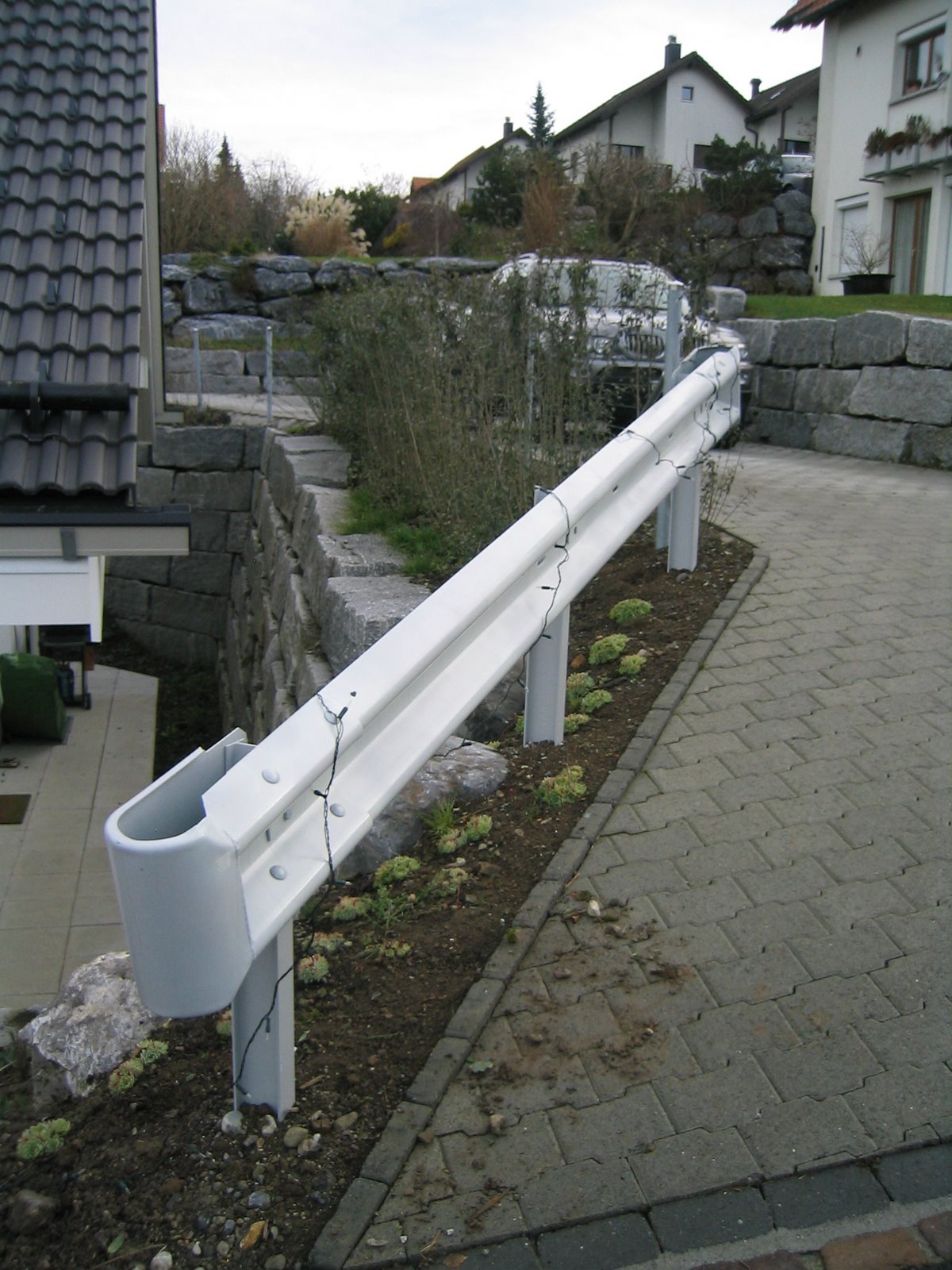
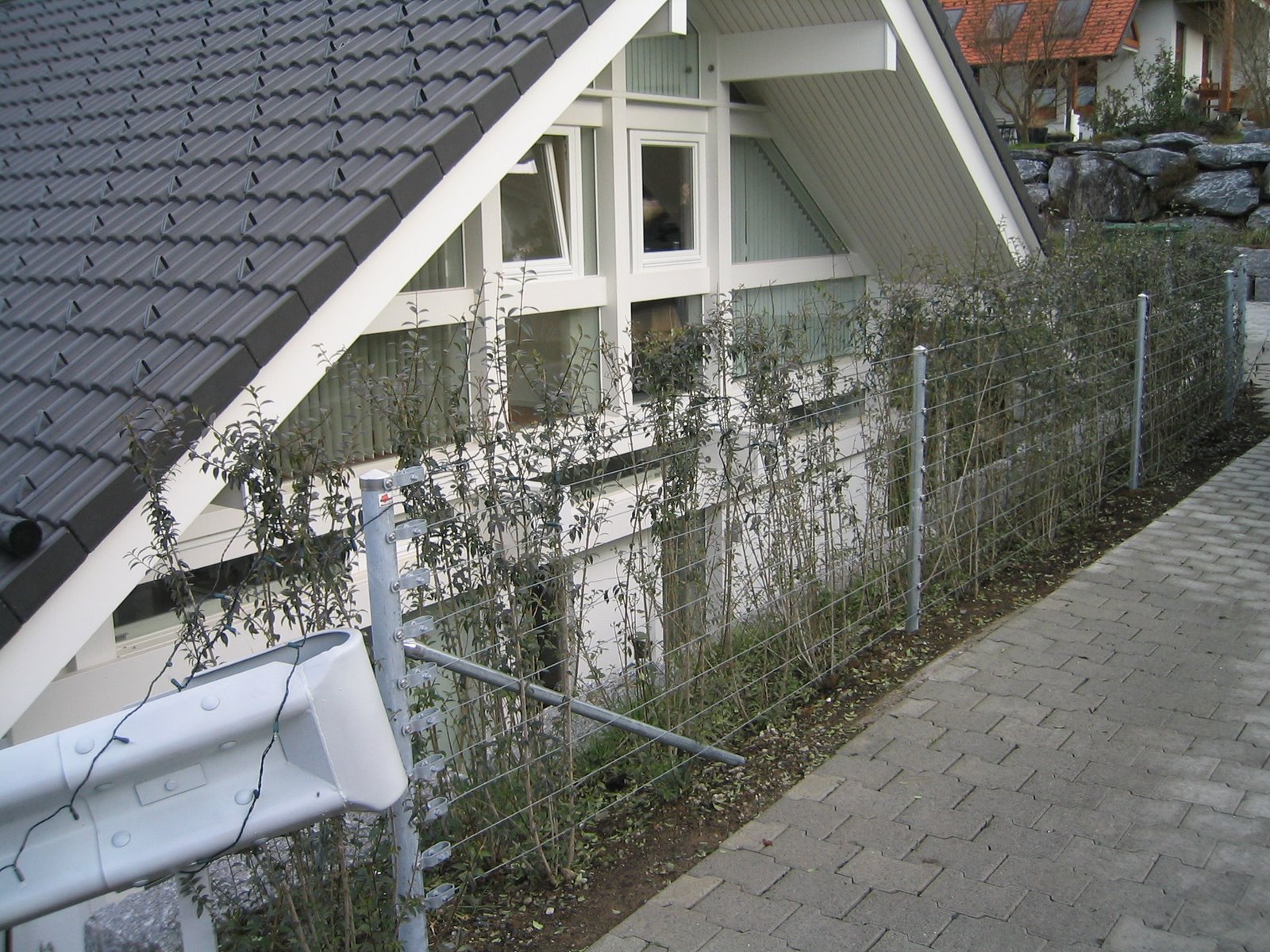
    Note the posh Biohort shed - aluminium, and bloody great. Bought a matching aluminium box for the outside cushions and sun-loungers. Also note the posh postbox, aluminium, and bloody great. I think we might have an aluminium thing going on... oh no, that soddin' great armco's made out of steel. As yet there's no paint on it, but I reckon it'll collect it's first ding sometime this winter.

    Couldn't resist the temptation to take a nerdy photo of the snow-thrower thingy. Nice colour innit?

    I think the photos also capture the progress in the garden quite nicely. The earth is there simply 'cos the gardener came last week and hoicked out the weeds - leaving plenty of gaps between the plants. Prior to that the whole area was a sea of green. Oh, and you'll see our infamous weed patch. Going to break someone's back to weed that lot out again. Broke mine last summer, so not doing it again.

    Oh, and the full splendor of our wooden decking/terrace. Well, fullish 'cos it is winter. Discussion with Frau Capucho this morning on that very subject - we built a huge one, but we're very glad we did. Now looking forwards to endless summers with the kids on one side, and Claudia and I on t'other with a glass of wine each.

    And that's that for now...


    Wednesday, November 28, 2007

    Winter is upon us - again

    Been a while since you lot got some sort of update, so here it is...

    We're... living in our house. The last significant step was the fencing and armco, but they've long become background features. We're now in that nice business-as-usual period of simply living in our beautiful Huf Haus, and wondering if we should buy this or that stick o' furniture for this or that nook or cranny. Not that yer Huf Haus has any nooks and crannies. As stated before, finding a wall to put a cupboard against is no mean task when the majority of yer walls are windows.

    The wooden flooring is bearing up - parquet floors are surprisingly durable if yer stick to the rock 'ard woods, and therefore inevitably the most expensive ones. Only major ding was done by yours truly last weekend, when he dropped a whopping thick glass jar on the kitchen floor - missed my foot (thankfully), jar survived, notch in the floor.

    The other thing that's bearing up very well is the central heating system. Oo! Oo! Meant to tell yer all about that. Mr Banking and IT here had absolutely no idea as to the significance of the heating system we ended up buying. Nuff said that it was supposed to save money (makes me happy) and generate copious amounts of heat on demand (makes Claudia happy) and all's well with the world. Turns out that the air/air heat pump system is actually fairly greenie. Not as green as a ground/air heat pump, mind, but then the local geology was against us on that. I'll say to anyone that it's a crime against nature that some form of heat pump isn't a mandatory requirement for any domestic new installation or replacement throughout the western world - which would reduce the rather pricy acquisition price still further. They're cheap to run, efficient, greenie and just bloody marvellous.

    One just hopes that one day it becomes so.

    I'll continue to day-dream about some form of solar power for the hot water (currently running 100% off the electricity) but will await developments before I commit. Surely there's a market for roof tile-shaped solar panels? And surely someone can design one that's snow-friendly enough for use half-way up a mountain? Current mountain area planning regulations take a dim view on solar panels 'cos snow readily slips off 'em thereby putting any visiting vicar at risk of a decapitation.

    What else?

    Good thing the pickies below are snow-bound because although we've found a local gardener to take care of the borders and grass and stuff, the uphill side of the garden is still a massive weed patch. We have a local landscape garden firm submitting a 'concept' very soon - although one mistrusts 'concepts'. 'Concepts' usually need copious amounts of money to 'realise'. Still, we'll have a butchers at whatever they come up with.

    And I've left the best and coolest thing for last. We've bought ourselves what's known as a snow-thrower - one of those lawn-mower looking machines that yer see on the telly sucking up snow at the front and then spraying it out of a nozzle on the top. Really bloody cool. Cleared our entire driveway with it in just a few minutes - a job that would have taken me an hour or more by hand and spade. Cost me about CHF 1,500 or, what's that, six hundred quid. Eek! Anyways, I'm made up with it. Four-stroke petrol powered, for those that understand such things, and light enough for Claudia to use it when I've succumbed to frostbite.

    Anyways, here're the long overdue pickies...